What are funding rates, and why do perps have them?
Funding rates exist because perpetual futures never expire. A dated future is dragged toward spot at settlement, when the two prices converge. A perp has no expiry date to force that convergence, so it needs a different anchor. Funding is that anchor.
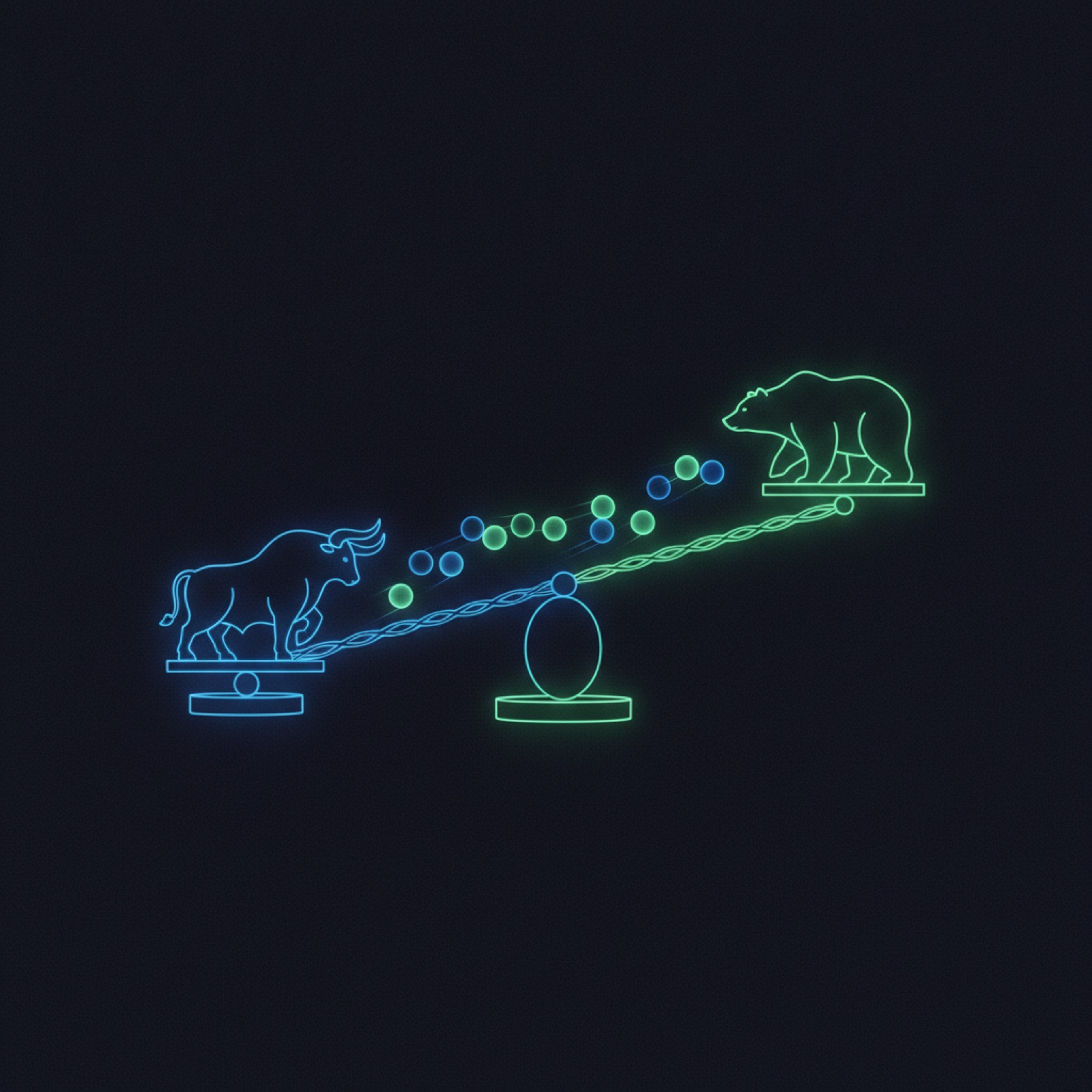
Every funding interval, one side pays the other based on how far the perp trades from an index (spot) price. When the perp trades above spot, longs are the crowded, aggressive side, so they pay shorts — which nudges the perp back down toward spot. When the perp trades below spot, shorts pay longs. The payment is the tether that keeps the contract honest. If you are new to the instrument itself, start with how perpetual futures actually work, then come back.
One thing to be clear about: funding is not a fee the exchange keeps. It moves peer-to-peer between traders. The venue only calculates and settles it. That distinction matters when you plan a strategy — you can be on the receiving side.
How is the perpetual funding rate calculated?
Most venues build the perpetual funding rate from two pieces: a premium/discount index (how far the perp's mark price sits from the spot index) and a small fixed interest-rate component. Binance, for example, uses an interest rate of 0.03% per day — 0.01% per 8-hour interval — and adds a premium that moves with the price gap. Hyperliquid uses the same 0.01%/8h interest anchor but settles hourly, with the rate clamped so a single interval can't run away.
The payment itself is simple: funding payment = position notional × funding rate. It's charged on your position size, not your margin. That detail bites leveraged traders. A $10,000 long at +0.01% funding pays $1 that interval, roughly $3 a day, or about 11% annualized at the 0.01%/8h baseline — but if that $10,000 position is backed by $1,000 of margin at 10x, the same $3/day is draining your collateral ten times faster in percentage terms. Read the funding cost against your equity, not your notional.
Intervals vary by venue, and they change the math:
- 8-hour funding (most centralized exchanges: Binance, Bybit, OKX) — settled three times a day. The quoted rate is per interval, so multiply by 3 for a daily figure.
- 1-hour funding (some perp DEXs, including Hyperliquid) — settled 24 times a day, using the spot oracle price to convert your position to notional. Hyperliquid also caps funding at 4% per hour so an extreme spike is bounded.
A recurring beginner mistake is comparing an 8-hour rate on one venue with an hourly rate on another as if they were the same number. They are not. Always normalize to the same window — daily or annualized — before you decide anything.
What do funding rates reveal about market positioning?
Funding is one of the cleaner sentiment reads available, because traders pay it with real money. A positive rate means the perp is trading above spot, which means leveraged longs are aggressive enough to hold above fair value and willing to pay for the privilege. A negative rate means shorts are the crowded, paying side.
The size and persistence tell the story:
- Near the 0.01%/8h baseline — roughly neutral. The market isn't leaning hard either way.
- Elevated and sustained positive — longs are crowded and paying up. That leverage is fuel for a long squeeze if price stalls.
- Deeply negative — shorts are crowded, often after a sharp drop. Short squeezes tend to start here.
Funding extremes flag crowded positioning, not timing. Rates can stay stretched for days in a strong trend, and "funding is high, so it must reverse" has liquidated plenty of contrarians. Treat it as one input that describes where the leverage sits, confirmed by price and open interest — not a standalone signal to fade the crowd.
How do bots harvest funding? (the funding rate strategy)
The core funding rate strategy is the cash-and-carry, or delta-neutral basis trade: buy the asset on spot and short an equal notional of the perp. The two legs cancel out directionally — if the price rises, your spot gains what your short loses — so you are left collecting funding whenever it's positive, with little exposure to which way the market moves.
The mechanics in practice:
- Long $10,000 of BTC spot, short $10,000 of the BTC perp. Net delta near zero.
- While funding is positive, the short leg receives payment every interval.
- At 0.01%/8h that's the ~11% annualized baseline; during frothy bull phases sustained rates of 30-100%+ annualized have appeared — and vanished just as fast.
This is the surviving cousin of classic arbitrage: it trades a real risk and a real capital commitment rather than pure speed, which is why smaller operators can still run it when they can no longer win latency races. It shows up on most lists of arbitrage that still works for exactly that reason. It is not free money, though. Funding can flip negative and turn your income into a cost. The short leg needs a margin buffer or a price spike can liquidate it, breaking the hedge at the worst moment. And your realized yield is net of trading fees, borrow costs, and the spread you pay to enter and exit both legs. Size it with the same discipline you'd apply anywhere else — the math in position sizing for bots applies directly to how much margin you leave on the short.
How do bots dodge funding costs?
If you are not harvesting funding, you are probably paying it — and a directional bot that parks on the crowded side of a hot market can lose more to funding than to bad trades. Dodging it is mostly about awareness and structure:
- Hold spot, not the perp, for long-only exposure. If you just want to be long for days or weeks, spot has no funding. You only need a perp when you want leverage or a short.
- Prefer the side being paid. When funding is deeply negative, a long perp receives funding instead of paying it. A bot that checks funding before sizing can let the payment work for it rather than against it.
- Account for the interval, not just the trade. A scalper flat most of the time barely touches funding; a swing bot holding through many intervals must price it into every entry. Some bots deliberately avoid carrying a large crowded-side position across a funding snapshot when the rate is extreme.
- Cut leverage. Funding scales with notional, so the same rate hurts a 10x position far more relative to margin than a 2x one. Lower leverage shrinks the funding drag along with liquidation risk — see how much leverage is too much.
The honest framing: for a directional strategy, funding is a cost of doing business, not something you can fully eliminate. The goal is to stop it quietly eroding an edge you thought was there.
What are the risks of trading funding rates?
Funding strategies get sold as "market-neutral income," which undersells the risk. The delta-neutral trade removes price direction, but it adds others:
- Funding flips. A positive rate you're harvesting can go negative, converting income into an ongoing cost until you unwind.
- Liquidation on the short leg. A fast rally can liquidate an under-margined short even though your spot is up an equal amount. The paper hedge is perfect; the margin engine is not.
- Basis and execution risk. Entering and exiting both legs costs spread and fees, and the basis can widen against you before it converges.
- Counterparty risk. Your spot and your short may sit on different venues; an exchange freezing withdrawals or de-pegging its stablecoin can break the trade.
- Rate caps and clamps. Venue-specific limits (like Hyperliquid's 4%/hour cap) bound the extremes in both directions, so a screenshot of a huge annualized rate rarely persists long enough to earn in full.
None of this makes funding trading unworkable. It makes it a real strategy with real risk, not the passive yield it's often dressed up as. As with any bot approach, most of the money is lost by people who underestimated the drawdown and over-sized the position — the same pattern behind most bot drawdowns that end accounts.
Frequently asked questions
What are funding rates in crypto?
Funding rates are periodic payments exchanged between long and short holders of a perpetual future to keep its price tied to spot. When the rate is positive, longs pay shorts; when negative, shorts pay longs. The exchange doesn't keep the payment — it moves peer-to-peer between traders on opposite sides.
How often is funding paid?
It depends on the venue. Most centralized exchanges (Binance, Bybit, OKX) settle funding every 8 hours, three times a day. Some perpetual DEXs, including Hyperliquid, settle hourly. Because the quoted rate is per interval, always normalize to a daily or annualized figure before comparing venues.
What does a high positive funding rate mean?
A high positive rate means the perp trades well above spot and leveraged longs are crowded and paying to stay in. It flags one-sided positioning and squeeze risk, but it is not a timing signal. Rates can stay stretched for days in a strong trend, so confirm with price and open interest.
Can you actually make money from funding rates?
Yes, through a delta-neutral basis trade: long spot and short the perp to collect funding while staying price-neutral. It is a real strategy, not free money. Funding can flip negative, the short leg can be liquidated in a rally, and fees and basis risk cut your yield. Size margin conservatively.
How is the funding payment calculated?
Funding payment equals your position notional multiplied by the funding rate for that interval. It's charged on position size, not margin, so leverage amplifies its effect on your collateral. At the common 0.01% per 8-hour baseline, that's roughly 11% annualized on the notional you hold.